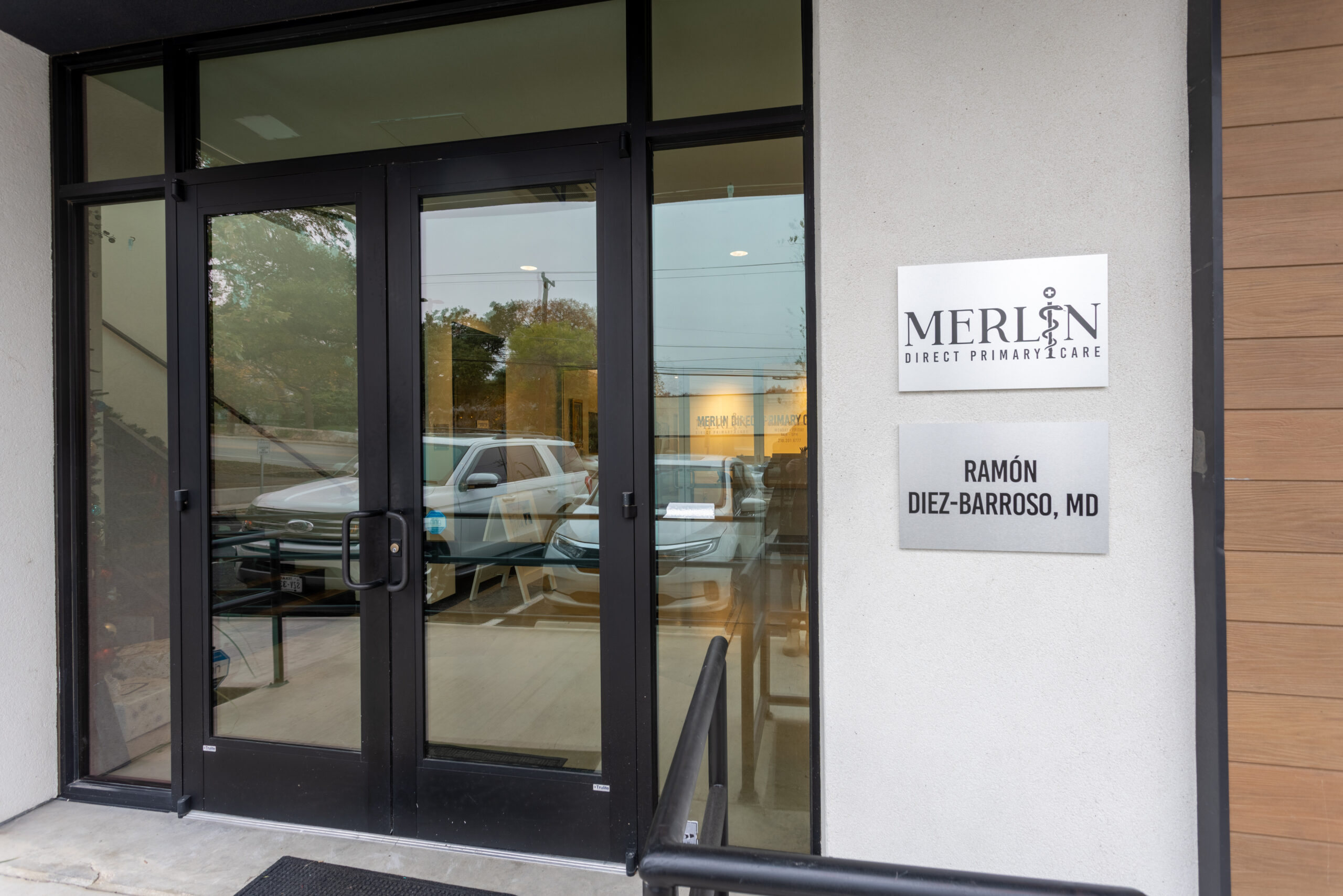
What Is Direct Primary Care? A San Antonio Doctor Explains
I became a family physician to practice medicine the way it is supposed to work: personal, unhurried, and centered on the person in front of me. In a traditional practice that is hard to do. Most doctors get ten to fifteen minutes per patient, and a good share of that goes to documentation and billing rather than to you.
Direct Primary Care is how I solved that. If you have never heard of it, you are not alone. Most people in San Antonio have not, and that is the reason I wrote this.
What is Direct Primary Care?
Direct Primary Care is a membership model for your primary care. You pay the practice directly through a flat monthly fee, and that fee covers your care with me. There is no insurance billing for routine visits, no copays, and no surprise bills for what the membership includes. At Merlin, adult membership is $150 per month and children under 18 are $25 per month.
How does it actually work?
You pay the practice directly instead of a plan paying it on your behalf. Because I am not billing insurance for routine care, I am not coding visits, chasing claims, or writing notes for a payer rather than for you. That removes most of the administrative weight from primary care, and the time it frees goes back into appointments.
Your membership covers unlimited office visits and unlimited telehealth visits, appointments that run 30 to 60 minutes, same-day or next-day availability by request, and direct access to me by phone and text. In-office procedures I perform are included at no additional visit charge.
Do I still need health insurance?
Yes. Direct Primary Care is not health insurance and it does not replace it. Your membership covers your primary care with me. You still need coverage for hospitalization, surgery, emergency care and specialist treatment. Most of my members keep an insurance plan for those things and use their membership for everything else.
Merlin Direct Primary Care does not bill insurance, Medicare or Medicaid. You pay the practice directly.
What is not included?
Lab work, imaging, pathology and specialist care happen outside my office, so they are not part of the membership. I will tell you what they cost before you agree to anything. I can order them at negotiated cash prices, or you can take them to your own lab or imaging center and use your insurance plan there if you would rather. Either way you know the number in advance instead of finding out from a bill six weeks later.
Why does this model mean longer appointments?
Because the panel is smaller, and that is the whole mechanism. A traditional primary care doctor often carries two to three thousand patients and sees twenty or more in a day. A Direct Primary Care doctor carries a small fraction of that.
Fewer patients means longer visits, follow-up that actually happens, and a doctor who knows your history rather than reading it off a screen while you talk. It also means you can bring more than one thing to an appointment. In a fifteen-minute visit you get one problem. In an hour you get your actual life.
How is it different from traditional primary care?
| Traditional primary care | Direct Primary Care | |
| How the doctor is paid | Insurance billing per visit | Flat membership fee |
| Visit costs | Copays, deductibles, surprise bills | Included in the membership |
| Appointment length | 10 to 15 minutes | 30 to 60 minutes |
| Getting seen | Often days or weeks | Same day or next day by request |
| Reaching your doctor | Phone tree, portal, callback | Phone and text, directly |
| Panel size | 2,000 to 3,000 patients | A small fraction of that |
Is this the same as concierge medicine?
They are related and they are not the same thing. Concierge practices usually keep billing insurance and charge a retainer on top, and those retainers often run into the thousands per year. Direct Primary Care replaces insurance billing for primary care with one straightforward fee, and that is what keeps it accessible. I practice Direct Primary Care.
Who does it work best for?
It suits people who want predictable costs and a real relationship with their doctor.
Families do well with it, because the cost is one number and getting a child seen the same day is straightforward. People managing blood pressure, cholesterol or diabetes do well with it, because those conditions need management time and management time is exactly what a rushed visit cannot give.
It also fits anyone carrying a high-deductible plan, who is already paying out of pocket for primary care whether they realize it or not. That includes a lot of people in their late fifties and early sixties who are not yet on Medicare, who are self-employed or early-retired, and who face the worst premium-to-value math in American healthcare. For them this is a straight cost comparison, and it usually is not close.
Is it worth it if I am healthy?
Some of my healthiest members joined for access rather than treatment. They want prevention taken seriously, they want someone who will pick up the phone, and they would rather catch something early than manage it later. Health is not a static thing you either have or do not have. What you are buying is the attention that keeps it.
Why I practice this way
I am not interested in seeing more patients faster. I am interested in a smaller number of people I actually know, whose histories I hold in my head, who can text me when their child spikes a fever on a Saturday.
That is not a premium add-on. That is what primary care was before it got industrialized, and it is what I moved to San Antonio to do. Because you deserve your doctor’s time.
Come and meet me
A Meet and Greet is free and there is no obligation. We sit down, you ask whatever you want, and you decide afterward whether this is right for you. Nobody signs anything at a Meet and Greet.
You can see the full pricing on the membership page, and the questions I get asked most are answered on the FAQ page. Or call the office at 210-201-6777.